When a house will not cool evenly, the outdoor AC unit often gets blamed first. Sometimes the equipment really is the issue. But in many Texas homes, the ductwork in the attic is just as important as the condenser outside.
Attic ducts live in a rough environment. The attic can get extremely hot, flex duct can be crushed or torn, insulation can fall away, and small leaks can waste a surprising amount of cooled air. A system can be mechanically healthy and still leave rooms hot if the ductwork is not delivering air properly.
This guide is not about crawling through dangerous attic spaces or doing duct repair without training. It is about knowing what to look for so you can describe the problem clearly and avoid replacing equipment when the duct system is the real suspect.
Why attic ductwork causes so many comfort problems
Ducts in conditioned space have an easier job. Ducts in a hot attic do not. In cooling season, supply ducts carry cold air through one of the hottest parts of the house. Return ducts may pull air back through the attic area if they leak. Both problems can hurt comfort and efficiency.
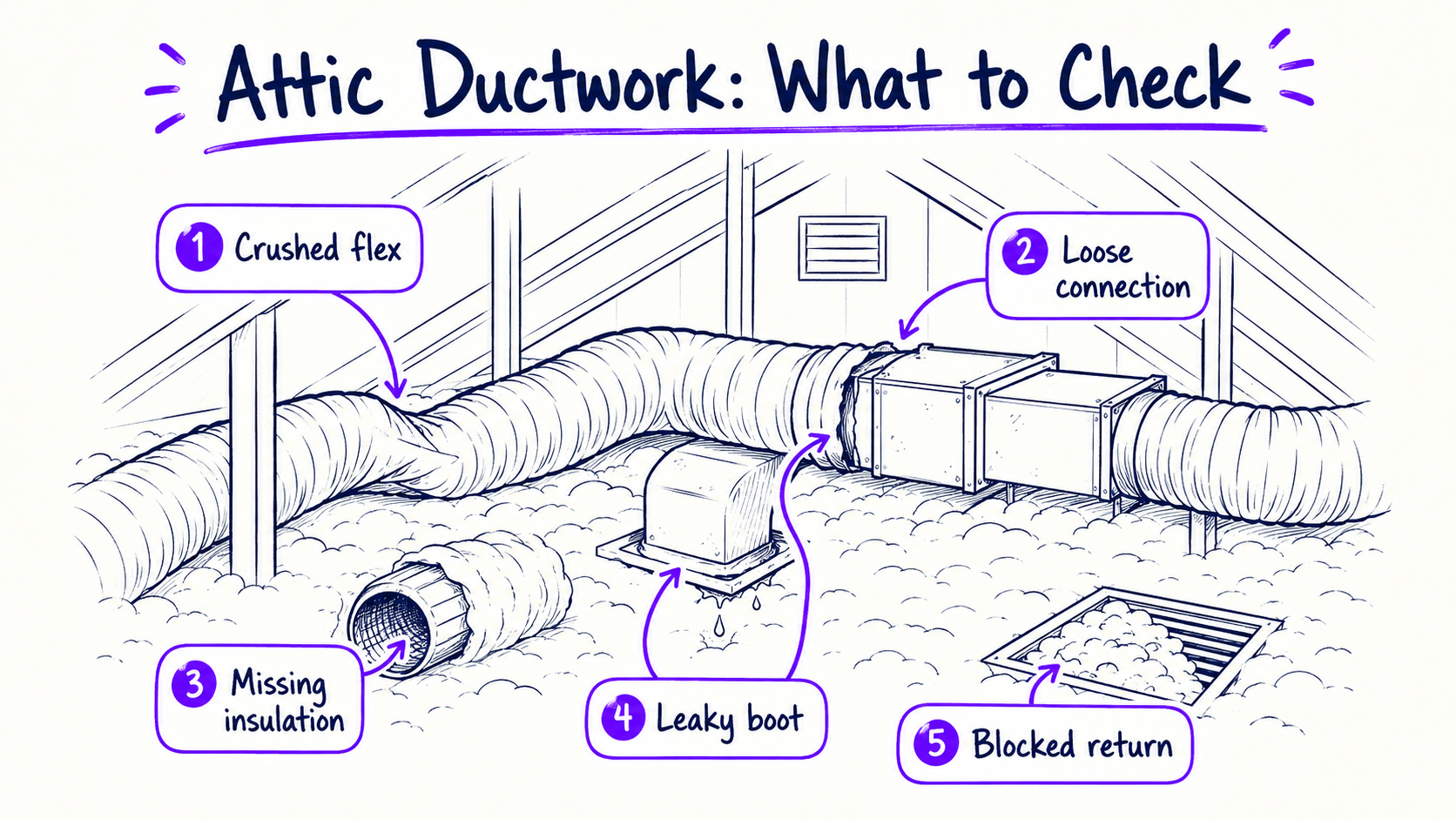
Common attic duct issues include:
- Disconnected duct runs
- Crushed or kinked flex duct
- Torn outer jacket
- Missing or damaged insulation
- Loose connections at plenums or boots
- Poorly sealed duct joints
- Long sagging duct runs
- Ducts lying directly on attic surfaces
- Return leaks pulling attic air
- Poorly sized ducts for the room load
Any one of these can make a room feel like the AC is weak.
First clue: the problem follows a room or area
If the whole house is warm and the AC runs constantly, the problem may be system-wide. If one bedroom, office, addition, or side of the house is always worse, think about duct delivery.
Room-specific duct clues include:
- One room gets weak airflow from the vent.
- A room is hot in the afternoon but acceptable in the morning.
- The room is far from the indoor unit.
- The room has a long flex duct run.
- The vent makes little noise or almost no airflow.
- The room has no good return-air path when the door is closed.
- The room has a lot of sun exposure or attic heat above it.
The equipment may be doing its job while the ductwork fails to deliver enough conditioned air where it is needed.
Visible attic duct checks from a safe position
Only enter an attic if it is safe, well lit, and you know where to step. Many ceilings cannot support body weight except on framing. If the attic is unsafe, too hot, too tight, or difficult to access, do not force it.
From the access point or a safe platform, look for obvious issues.
Disconnected ducts
A disconnected supply duct can dump cold air into the attic instead of the room. A disconnected return can pull attic air into the system. Either one is a real problem.
Clues include:
- A duct lying loose near a metal box or plenum
- Air blowing in the attic while the system runs
- A room with almost no airflow
- Dust patterns around a loose return connection
Crushed or kinked flex duct
Flex duct should have smooth, supported runs. Sharp bends, crushed sections, and long sagging loops restrict airflow.
Look for:
- Ducts pinched under boards, boxes, or stored items
- Tight bends near the air handler
- Ducts folded sharply around framing
- Long runs hanging like hammocks
- Sections flattened by foot traffic or storage
A crushed duct can make a vent feel weak even if the blower is working hard.
Damaged insulation
Duct insulation keeps cooled air cold as it travels through the attic. If insulation is torn, missing, wet, or pulled away, the duct can gain heat before the air reaches the room.
Look for silver or gray outer jacket damage, exposed inner duct, or sections that look much thinner than others.
Poor connections at boots
The boot is the box or fitting where the duct connects to the ceiling register. Loose or leaky boots can spill air into the attic or pull attic dust into the home.
Signs include:
- Dust streaks around vents
- Loose ceiling registers
- Gaps around the boot
- Insulation disturbed around the register area
Return ducts are just as important as supply ducts
Homeowners often focus on supply vents because that is where cold air comes out. But return airflow is the other half of the system. If the system cannot pull enough air back, it cannot deliver enough air out.
Return problems can include:
- Undersized return ducts
- Blocked return grilles
- Leaky return boxes in the attic
- Dirty return grilles
- Bedrooms with no return path when doors are closed
- Filter racks with gaps pulling attic air
A leaky return in an attic is especially bad because it can pull hot, dusty attic air into the system. That makes the AC work harder and can dirty the coil.
Why closing vents can backfire
It seems logical to close vents in unused rooms and push more air to the rooms you care about. In some homes, closing one or two vents slightly may not cause much trouble. But closing multiple vents can increase static pressure, reduce airflow, and make the blower work against more restriction.
Instead of treating closed vents as a fix, use them as a clue. If you need to close half the house to make one room tolerable, the duct design or balancing needs attention.
Duct leakage versus equipment failure
A leaky supply duct in the attic can make it seem like the AC is undersized. A leaky return duct can make it seem like the AC is not cold enough. Both issues can create long run times and uneven comfort.
Signs that ducts may be involved:
- Utility bills are high compared with comfort level.
- The AC runs a lot but certain rooms stay hot.
- The attic feels cool near duct connections while the system runs.
- The return area is dusty or noisy.
- The filter gets dirty quickly.
- There are strong temperature differences room to room.
- Ducts are visibly damaged, sagging, or disconnected.
Equipment should not be judged in isolation. Ducts are part of the installed system.
What a technician may test
A technician may inspect and test:
- Supply and return duct condition
- Airflow at registers
- Static pressure
- Temperature difference across the system
- Duct leakage
- Blower performance
- Coil condition
- Return-air sizing
- Room-by-room load and balancing
- Insulation and attic heat factors
Sometimes the fix is simple, like reconnecting a duct. Sometimes it requires redesigning return air, replacing damaged flex duct, sealing ducts, or correcting poor layout.
When ductwork should be repaired before equipment replacement
If an existing system is struggling because ducts are damaged or poorly designed, replacing the outdoor unit may not solve the comfort problem. New equipment connected to bad ducts can still perform badly.
Duct evaluation is especially important before AC replacement if:
- Rooms have never cooled evenly.
- The current system is noisy.
- Filters collapse or whistle.
- The return is undersized.
- Ducts are visibly crushed or poorly routed.
- The home has additions or converted spaces.
- The old system had repeated coil freezing or airflow complaints.
A better equipment quote should consider the duct system, not just the tonnage of the old unit.
FAQ
Can bad ductwork make my AC seem weak?
Yes. Disconnected, leaky, crushed, undersized, or poorly insulated attic ducts can make a working AC system feel weak or uneven.
Why is one room hotter than the rest of the house?
Common causes include poor duct airflow, long duct runs, sun exposure, inadequate insulation, closed doors without return air, or a duct leak serving that room.
Is flex duct bad?
Flex duct is common and can work when installed correctly. Problems happen when it is crushed, kinked, unsupported, too long, poorly sealed, or poorly sized.
Should I seal attic ducts myself?
Minor visible gaps around registers may be homeowner-friendly, but attic duct sealing and repair often requires proper materials, safe access, and knowledge of airflow. Do not use standard cloth duct tape as a permanent duct repair.
Should ductwork be checked before replacing an AC?
Yes, especially if the home has uneven rooms, noisy airflow, high bills, or known attic duct issues. New equipment cannot fully overcome bad ductwork.
Related guides
- Static Pressure Basics: Why Airflow Problems Fool People
- AC Not Blowing Cold Air? Start With These Safe Checks
- Is Air Duct Cleaning Worth It? A Straight Answer
- Better Thermostat Settings for a Texas Summer
Sources worth reading
- U.S. Department of Energy ducts and air sealing: https://www.energy.gov/energysaver/ducts-and-air-sealing
- ENERGY STAR duct sealing information: https://www.energystar.gov/saveathome/seal_insulate/ducts
- ACCA homeowner resources: https://www.acca.org/homeowners
WHEN TO REQUEST SERVICE
Need help with this issue in Ferris or nearby Ellis County?
Submit a request and we will review it for local follow-up. Include what the system is doing, when it started, and anything you have already checked.