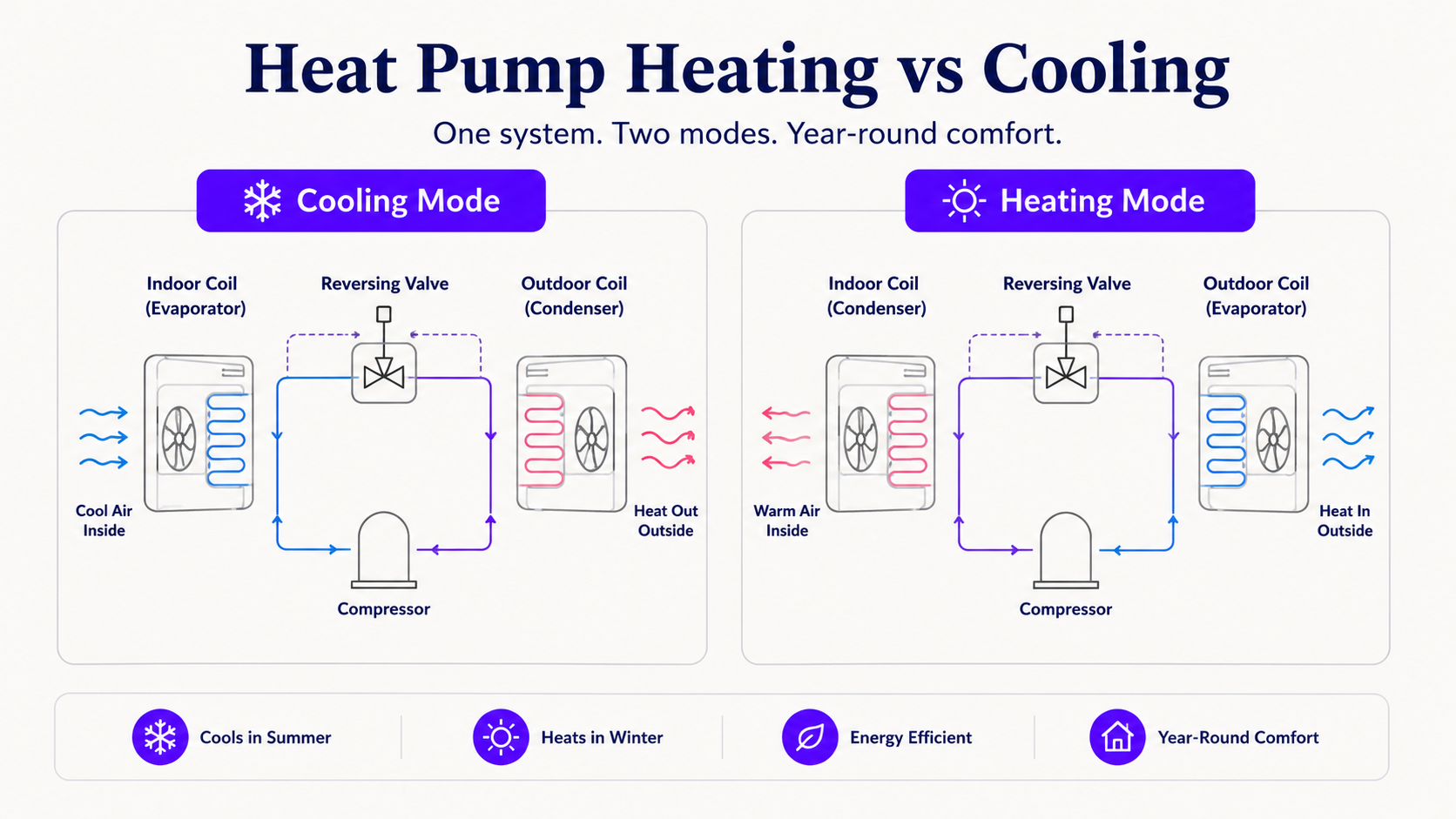
A heat pump is different from a straight-cool AC with a furnace. It can cool the house in summer and heat the house in winter by moving heat in different directions. When it seems stuck heating or cooling, the problem may be as simple as a thermostat setting, or it may involve the reversing valve, defrost controls, wiring, sensors, or refrigerant circuit.
The important part is not to force the system or start replacing parts based on a guess. Start with the basics, identify the pattern, and know when the next step needs a technician.
What “stuck” can mean
Homeowners use “stuck” to describe several different symptoms:
- The system blows warm air when set to Cool.
- The system blows cool air when set to Heat.
- The outdoor unit runs but the indoor air does not feel right.
- The system changes modes but takes a long time to feel different.
- The thermostat says Heat or Cool, but the system does the opposite.
- The outdoor unit makes a whoosh sound and steam appears in winter.
- Auxiliary heat runs more than expected.
- Emergency Heat was turned on by accident.
Each symptom points in a different direction.
Make sure the thermostat mode is right
Before thinking about reversing valves or expensive parts, check the thermostat carefully.
Confirm:
- Mode is set to Cool when cooling is needed.
- Mode is set to Heat when heating is needed.
- Emergency Heat is not on unless intentionally selected.
- The set temperature is clearly above or below the indoor temperature.
- The schedule is not switching modes automatically.
- The thermostat is configured for a heat pump, not a conventional furnace/AC setup.
Thermostat setup matters more with heat pumps because the thermostat has to control compressor operation, reversing valve logic, auxiliary heat, and sometimes outdoor temperature lockouts.
If a thermostat was recently replaced and the heat pump immediately started behaving backward, wiring or configuration is a major suspect.
Understand the reversing valve in plain English
The reversing valve is the part that lets a heat pump change the direction of refrigerant flow. That is how the same outdoor unit can provide heating and cooling.
Depending on the brand and setup, the reversing valve may be energized in cooling or energized in heating. If the thermostat is wired or configured incorrectly, the system can call for one mode while the equipment operates in the other.
Possible reversing valve/control symptoms include:
- Warm air in cooling mode
- Cool air in heating mode
- Mode changed at the thermostat but equipment does not change correctly
- Issue began after thermostat replacement or wiring work
- Outdoor unit runs normally but the delivered air is wrong for the selected mode
Diagnosing a reversing valve is not a homeowner task. It involves electrical controls, refrigerant operation, and system-specific wiring.
Do not mistake defrost mode for a failure
In cold weather, a heat pump may enter defrost mode to clear frost from the outdoor coil. During defrost, the system temporarily changes operation, the outdoor fan may stop, steam may rise from the outdoor unit, and the sound may change.
This can look strange if you have never noticed it before. A brief whoosh, fog/steam, or temporary change during winter operation can be normal.
Defrost may be abnormal if:
- The outdoor unit stays heavily iced for a long time.
- The system repeatedly enters defrost and never heats well.
- Ice covers the unit beyond normal light frost.
- The outdoor fan does not operate correctly.
- The house temperature keeps dropping.
- Auxiliary heat runs constantly to compensate.
Normal defrost is temporary. A heat pump encased in ice is not normal.
Auxiliary heat versus Emergency Heat
Many heat pump systems have backup electric heat or another auxiliary heat source. Auxiliary heat may come on automatically when the heat pump cannot keep up, during defrost, or when the thermostat is raised several degrees.
Emergency Heat is different. Emergency Heat usually tells the system to use backup heat instead of normal heat pump operation. It is meant for specific situations, such as a heat pump failure, not everyday use.
If the home is heating but electric bills spike, check whether Emergency Heat was accidentally enabled. Also avoid making large thermostat jumps in winter, because that can bring on auxiliary heat more often.
Check breakers and outdoor-unit behavior safely
From a safe distance, check whether the outdoor unit runs when it should.
In cooling mode, the outdoor unit should generally run when cooling is called. In heat mode, the outdoor unit also usually runs because the heat pump is using the outdoor unit to move heat.
Look for:
- Outdoor fan not spinning when the system is calling
- Loud hum or buzzing
- Breaker tripped
- Ice covering the outdoor unit in winter
- Outdoor unit silent while indoor blower runs
- Indoor air moving but not changing temperature
Do not open electrical panels or repeatedly reset breakers. If a breaker trips again, leave it off and request service.
When the air feels “not warm enough” in heat mode
Heat pump supply air often feels cooler than furnace air. A gas furnace may deliver very warm air. A heat pump may deliver air that is warm enough to heat the home but not hot to the hand.
Instead of judging by feel alone, watch the indoor temperature. If the thermostat is set to 70°F and the house slowly rises from 67°F to 70°F, the heat pump may be working normally. If the house temperature keeps falling while the system runs, there is a performance problem.
When the air feels warm in cooling mode
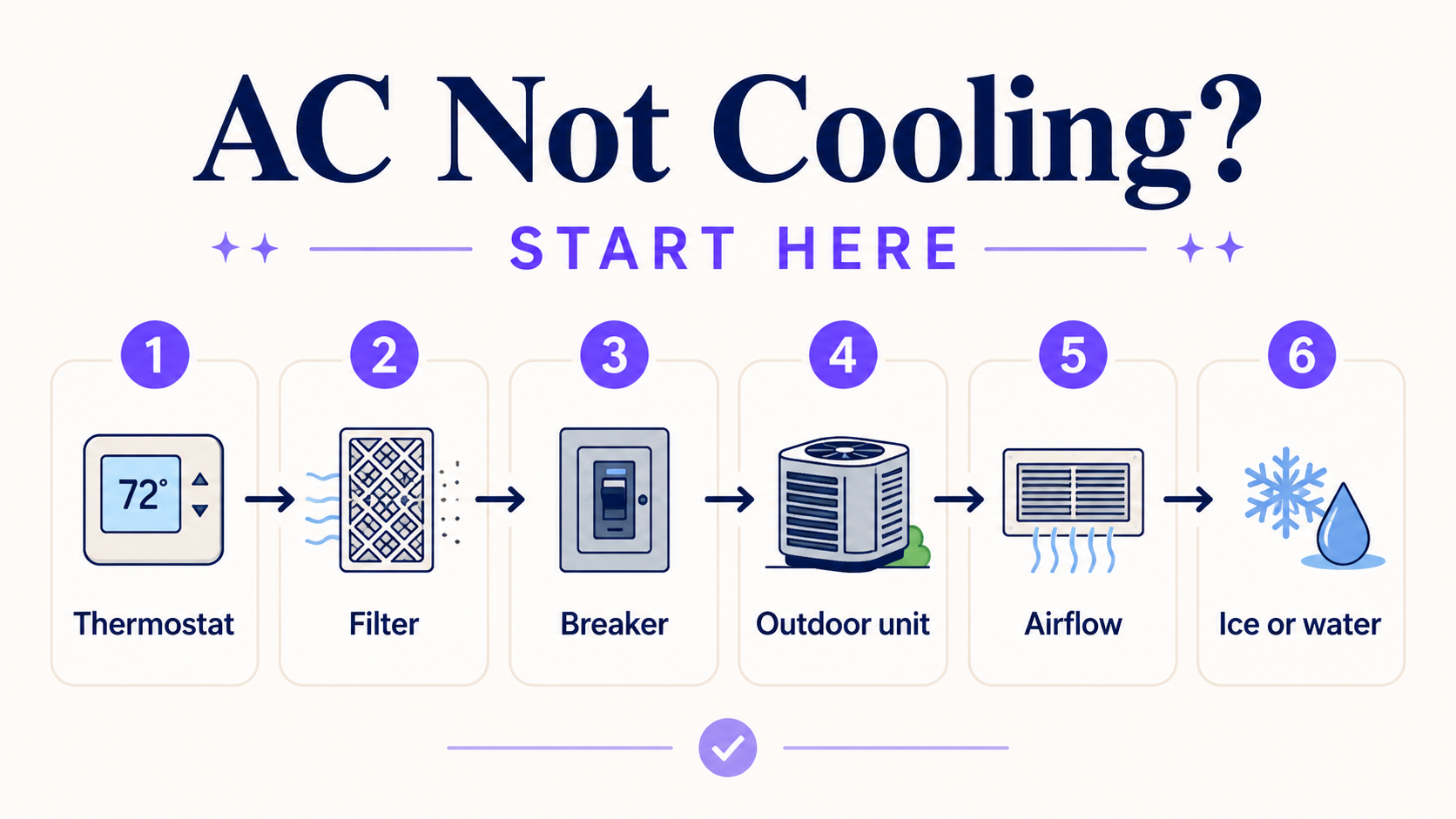
If cooling mode delivers warm or room-temperature air, check the basics:
- Thermostat is in Cool mode.
- Fan is set to Auto.
- Filter is clean.
- Outdoor unit is running.
- Breaker is not tripped.
- No ice is visible.
- Supply vents are open.
If those basics check out and the system still heats or blows warm air in cooling mode, it may be a reversing valve/control issue, refrigerant issue, compressor issue, or thermostat wiring problem.
Recent thermostat replacement is a major clue
If the problem started after installing a smart thermostat, do not ignore that timing. Heat pump thermostats need the right wiring and setup selections.
Common setup issues include:
- Wrong system type selected
- Reversing valve setting wrong
- O/B terminal configured incorrectly
- Auxiliary heat setup wrong
- Missing common wire issue
- Old thermostat wiring copied without understanding system type
A thermostat can power on and still be configured wrong.
When to request heat pump service
Request service if:
- The system heats in Cool mode or cools in Heat mode.
- The issue started after thermostat replacement.
- The outdoor unit is not running when it should.
- The breaker trips.
- The outdoor unit is heavily iced.
- The system runs constantly but cannot change indoor temperature.
- Emergency Heat is the only way the home heats.
- Auxiliary heat runs constantly.
- There is a burning smell, buzzing, or electrical concern.
Heat pumps combine airflow, refrigerant, electrical controls, and thermostat logic. Once the basic settings are verified, deeper diagnosis should be done properly.
FAQ
Why is my heat pump blowing warm air in cooling mode?
Possible causes include thermostat mode/configuration issues, reversing valve problems, electrical/control issues, refrigerant problems, or an outdoor unit that is not operating correctly.
Why is my heat pump blowing cool air in heat mode?
Heat pump air may feel cooler than furnace air, but the home should still warm over time. If the indoor temperature falls, the system may have a performance, control, auxiliary heat, or refrigerant problem.
What is Emergency Heat?
Emergency Heat usually uses backup heat instead of normal heat pump operation. It should not be used as a normal heating mode unless there is a specific reason.
Is steam from my outdoor heat pump normal in winter?
Brief steam or fog during defrost can be normal. Heavy ice that does not clear or repeated defrost problems are not normal.
Can a smart thermostat make a heat pump run backward?
Yes. If the thermostat is wired or configured incorrectly for the heat pump, it can call for the wrong mode or fail to control auxiliary heat properly.
Related guides
- Better Thermostat Settings for a Texas Summer
- AC Not Blowing Cold Air? Start With These Safe Checks
- Static Pressure Basics: Why Airflow Problems Fool People
- Inside Your Air Handler: The Parts Homeowners Should Recognize
Sources worth reading
- U.S. Department of Energy heat pump systems: https://www.energy.gov/energysaver/heat-pump-systems
- ENERGY STAR air-source heat pumps: https://www.energystar.gov/products/air_source_heat_pumps
- ENERGY STAR heating and cooling maintenance: https://www.energystar.gov/campaign/heating_cooling/maintenance_checklist
WHEN TO REQUEST SERVICE
Need help with this issue in Ferris or nearby Ellis County?
Submit a request and we will review it for local follow-up. Include what the system is doing, when it started, and anything you have already checked.